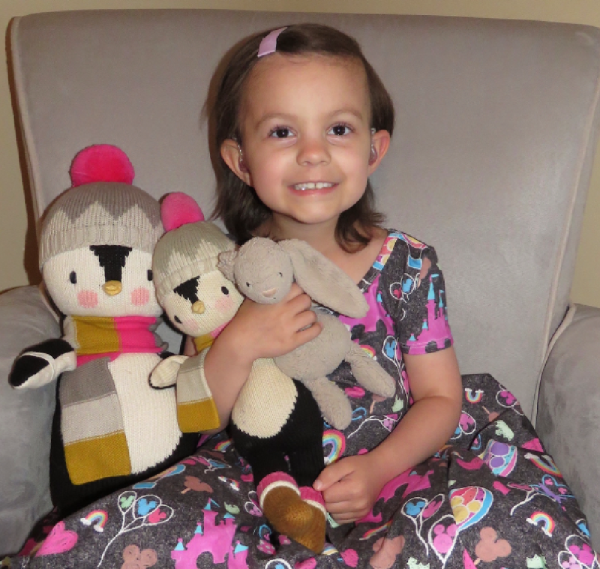
Finley was diagnosed at 27 months old with classic medulloblastoma, group 3, MYC-amplified. Her symptoms were frequent falling, vomiting (clear and egg-yolk in appearance, with rapid onset on the day of diagnosis), headaches throughout the week prior to diagnosis, and sensitivity to loud noises when they had never bothered her before (e.g., a lawnmower). From the start, Finley was considered high risk due to her age and the fact that she had metastases down her spine.
There are roughly only 50 children diagnosed under the age of 3 out of the 350–500 cases of medulloblastoma diagnosed annually in the entire United States. It has been discovered that medulloblastoma is present from birth, but even in 2026, doctors still do not know what causes it. Finley’s was not genetic, although some cases are. Standard treatment is surgery, chemotherapy, and radiation. All can come with long-term effects and the possibility of secondary cancers.
There are different types of histology: classic, anaplastic, and desmoplastic. There are four molecular subgroups: group 3, group 4, WNT, and SHH. Five-year survival varies depending on the subtype. Typically, group 3 has the worst prognosis, with a five-year survival rate of under 35%.
After the surgical removal of a 5 cm tumor from her cerebellum, Finley completed Children’s Oncology Group ACNS0334 protocol. She had three months of induction chemotherapy at Brenner, three high-dose chemotherapy cycles with autologous stem cell transplants at Levine, and six weeks of proton radiation at Emory, where she underwent daily anesthesia.
She spent close to 200 days inpatient and had five surgeries (resection, Broviac placement, G-tube placement, Broviac removal, and port placement), lumbar punctures, countless blood draws, countless ED visits, blood transfusions, platelet transfusions, monthly IV antibiotics, daily medications, immunotherapy, frequent MRIs, and monthly maintenance chemotherapy.
After her resection, Finley temporarily lost the ability to walk. Some children lose this ability altogether, while others may become blind or deaf. All children suffer the equivalent of a traumatic brain injury, which can lower IQ and affect cognitive abilities. Finley developed high-frequency hearing loss due to chemotherapy and wore bilateral hearing aids.
Finley was stable (no evidence of disease) on her immunotherapy clinical trial with Dr. Johnson for two years. However, due to concerns about secondary cancers, we decided to stop treatment in March 2023.
Unfortunately, a week later, we noticed bruising under her left eye and knots on her left temple. After moving up her MRI and having a PET scan, we learned that she had relapsed with disseminated disease at the beginning of April. Large tumors were found in her liver and lung. The knots on her left temple were due to bone metastases. Her tumors had spread outside the cerebrospinal fluid and throughout her body. According to Dr. Theodore Johnson, who has more than 20 years of experience treating relapsed medulloblastoma, this happens in only about 1–3% of medulloblastoma cases.
Finley was able to resume the clinical trial, but it was short-lived because her platelets could not recover to the required threshold. She was able to take etoposide and tolerated it well, but it was only a means of attempting to buy more time. There was no cure for our precious daughter, and it was only a matter of time before we would have to say goodbye to our beloved Finley.
Finley had another PET scan in June that revealed widespread progression. Her disease had also spread to her jaws, creating pain and swelling that made eating very challenging. At this point, we had to resort to bolus feeds to keep her weight up. Finley received radiation treatment to her jaw, which alleviated her swelling and pain.
Finley spent the summer of 2023 visiting family and making memories. We were grateful that she was able to start kindergarten, but her attendance was short-lived due to rapid progression and pain. During the last few months of Finley’s life, she continued to go for weekly labs and received palliative radiation.
We said goodbye to our precious Finley on November 9, 2023, shortly after 6 p.m.
We learned after Finley died that the lump under her left arm was actually one of her ribs that had been pushed up due to tumor progression. Despite the immense pain Finley endured during the last few months of her life, she continued to live her life to the fullest up until the very end, and most importantly, she did so joyfully.
Finley and other kids like her deserve so much more.
Dave and Theresa Price